
A wound is more than an injury to the skin. While many minor wounds heal with appropriate basic care, some wounds take longer than expected to heal, repeatedly break down, become infected, or are complicated by underlying medical conditions.
For these wounds, simply changing the dressing may not be enough. Complex wound care requires us to look at the wound itself, understand why healing may be delayed, identify contributing medical and mechanical factors, and develop an individualised management plan.
At Poliklinik Shaik, our wound care approach considers both the wound and the person behind it – including overall health, circulation, mobility, pressure, nutrition, sensation and underlying disease.
What Is a Complex Wound?
A complex wound is a wound that requires more detailed assessment or ongoing management because healing may be affected by the wound itself, an underlying medical condition, or other contributing factors.
- Diabetic foot wounds
- Chronic or non-healing wounds
- Pressure injuries
- Venous leg ulcers
- Arterial ulcers
- Infected wounds
- Complicated surgical wounds
- Traumatic wounds
- Recurrent wounds
- Wounds with significant tissue loss
Some wounds may appear small on the surface but have deeper involvement. Others may initially improve before becoming stagnant or deteriorating. Understanding why a wound is not healing is therefore just as important as treating what is visible.
Understanding the Normal Wound Healing Process
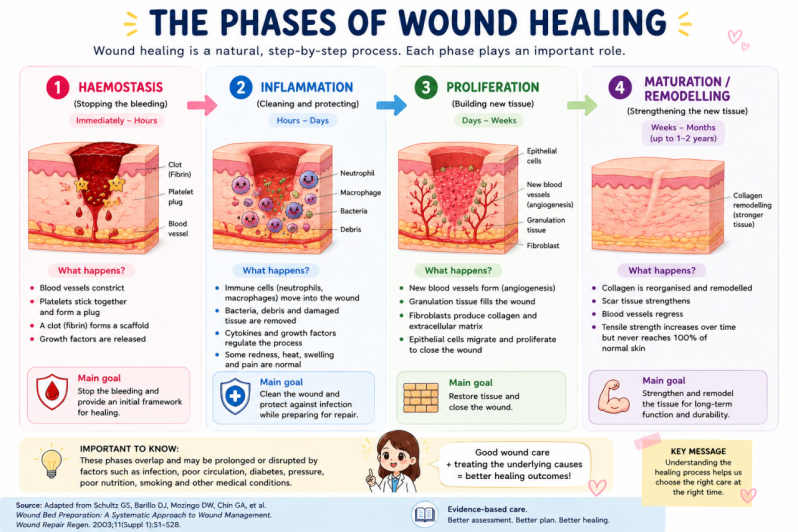
Wound healing is a dynamic process. The phases overlap rather than occurring as completely separate steps, but they are commonly described as haemostasis, inflammation, proliferation and maturation/remodelling.
1. Haemostasis – Stopping the Bleeding
Immediately after injury, the body works to control bleeding. Blood vessels constrict and a clot forms, providing an early framework for repair.
2. Inflammation – Cleaning and Protecting the Wound
Inflammation is a normal and necessary part of healing. Immune cells enter the wound to help remove microorganisms, damaged tissue and debris and prepare the wound for repair.
3. Proliferation – Building New Tissue
New blood vessels and granulation tissue develop, the wound begins to contract, and skin cells migrate across the wound surface as repair progresses.
4. Maturation / Remodelling – Strengthening the Tissue
After closure, newly formed tissue continues to reorganise and strengthen. Remodelling may continue for months after the wound has closed.
Why Can a Chronic Wound Become “Stuck” in Inflammation?
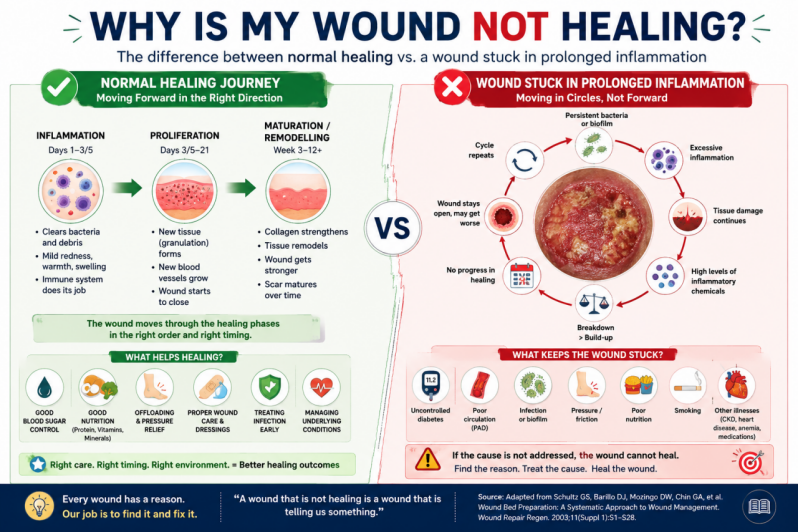
In a normally healing wound, inflammation gradually resolves and the wound progresses towards proliferation and tissue repair. In some chronic or complex wounds, however, the inflammatory response becomes prolonged or dysregulated.
Ongoing infection or high microbial burden, devitalised tissue, repeated pressure or trauma, poor tissue perfusion, diabetes and other systemic illnesses can continue to stimulate the inflammatory environment. Persistent inflammatory cells, proteases and oxidative stress may damage extracellular matrix and proteins needed for repair, while angiogenesis and effective tissue regeneration may be impaired.
The result is a wound that remains in a chronic inflammatory state and fails to progress efficiently into the proliferative phase. This is one reason a wound may remain open despite repeated dressing changes.
Complex wound management therefore aims not only to cover the wound, but to identify and address the factors that are keeping the wound in this non-healing cycle.
Why Dressing Alone May Not Be Enough
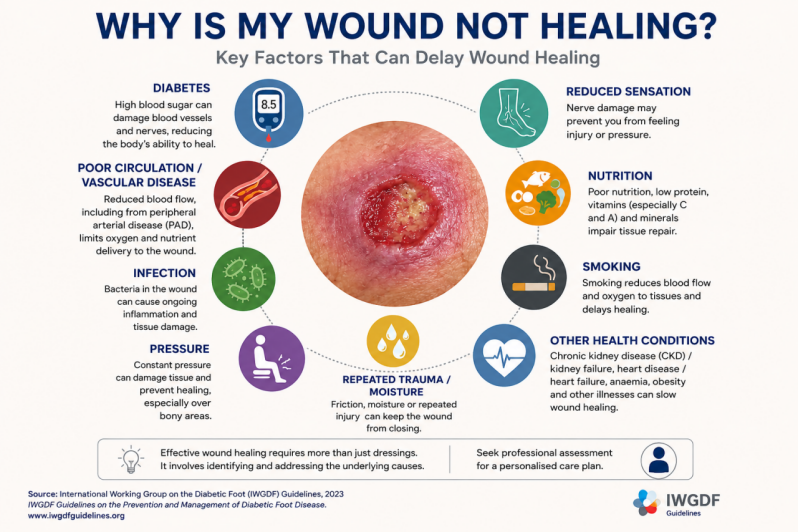
A dressing is an important part of wound management, but it is only one component. When a wound fails to heal as expected, the underlying cause and systemic factors need to be considered.
Diabetes mellitus
Hyperglycaemia, neuropathy, immune dysfunction, vascular disease and impaired cellular repair can all contribute to delayed healing and increased infection risk.
Peripheral arterial disease (PAD) and other vascular disease
Reduced arterial perfusion limits delivery of oxygen and nutrients to tissue. Venous disease can also contribute to oedema and chronic ulceration. Vascular assessment may therefore be crucial in selected wounds.
Chronic kidney disease (CKD) and kidney failure
Advanced kidney disease may be associated with anaemia, uraemia, nutritional problems, immune dysfunction, oedema, vascular calcification and a high burden of PAD. These factors can make wound healing more difficult, particularly in people with diabetes and in those receiving dialysis.
Heart disease and heart failure
Cardiovascular disease often coexists with diabetes, kidney disease and PAD. In heart failure, reduced circulatory reserve and peripheral oedema may further complicate tissue health and wound management. The patient’s overall cardiovascular status should therefore be considered as part of whole-patient assessment.
Infection
Local or deeper infection can cause ongoing tissue damage, amplify inflammation and interfere with progression towards healing.
Pressure and repeated trauma
Persistent pressure, shear or repeated loading can continually re-injure tissue. Offloading is particularly important for selected diabetic foot and pressure-related wounds.
Reduced sensation / neuropathy
A patient may not feel pain, pressure or repeated injury, allowing tissue damage to continue unnoticed.
Reduced mobility
Limited mobility may increase pressure exposure, contribute to oedema and make self-care more difficult.
Nutrition and general health
Adequate energy, protein, micronutrients and overall medical stability support tissue repair. Nutritional problems may coexist with chronic disease and complex wounds.
Smoking, medications and repeated local trauma
These may also affect perfusion, immune response, bleeding, tissue repair or the ability of the wound to progress.
Comprehensive Wound Assessment: Looking Beyond the Surface
The assessment begins with the wound’s location, size, depth, pain, duration and changes over time. The wound bed can then be assessed systematically using TIME.
A structured local wound assessment can be guided by the TIME framework for wound bed preparation:
T – Tissue
Assess the wound bed for viable and non-viable tissue, including granulation tissue, slough, necrosis/eschar, callus, debris and other barriers to healing.
I – Infection / Inflammation
Assess for local or spreading infection and for excessive or persistent inflammation that may delay progression through healing.
M – Moisture
Assess the amount and type of exudate and whether the wound is too dry, appropriately moist, or excessively wet with risk of maceration.
E – Edge
Assess whether the wound edges are advancing, non-advancing, undermined, rolled or otherwise abnormal, together with the condition of the surrounding skin.
TIME provides a systematic way to assess local barriers to healing, but it should be used as part of a broader assessment of the whole patient and the underlying cause of the wound.
Depending on the wound and the patient’s condition, whole-patient assessment may also consider:
- Medical history and underlying diseases
- Diabetes control
- Kidney function, chronic kidney disease or kidney failure
- Heart disease or heart failure
- Peripheral arterial disease, venous disease and overall circulation
- Mobility and pressure exposure
- Sensation / neuropathy
- Nutritional status
- Medications, supplements and other therapies
- Allergies and sensitivities
- Ability to manage wound care at home
By assessing both the wound and the patient, the healthcare team can better identify factors delaying healing and decide whether further investigation, treatment modification or referral is required.
Individualised and Advanced Wound Management
There is no single dressing or treatment suitable for every wound. Treatment is selected according to the wound characteristics, underlying cause, healing phase, comorbidities and individual needs of the patient.
Wound Hygiene
Before selecting advanced wound dressings, wound bed preparation and Wound Hygiene are important components of care. Wound Hygiene is a structured approach aimed at reducing barriers such as devitalised tissue, debris and biofilm, where clinically appropriate.
1. Cleanse
Cleanse the wound bed and surrounding skin to remove loose debris, contaminants and wound exudate.
2. Debride
Remove non-viable tissue, slough, debris and other material that may interfere with healing, using an appropriate method based on assessment, perfusion, patient tolerance and clinician scope.
3. Refashion the Wound Edge
Where appropriate, address non-viable, thickened, rolled or undermined wound edges that may act as a barrier to epithelial advancement.
4. Dress
Select an appropriate dressing based on the wound assessment, exudate, tissue condition, infection or biofilm risk, surrounding skin and treatment goals.
These steps are reassessed and repeated as clinically appropriate. Wound Hygiene does not replace management of the underlying aetiology, perfusion, pressure, infection or systemic disease.
Advanced Wound Dressings
Dressing selection may depend on tissue type, wound depth, exudate, infection risk, surrounding skin and treatment goals.
Infection Assessment and Management
Wounds are monitored for local and systemic infection. Further medical treatment, investigation or referral may be required when infection is suspected.
Pressure Management and Offloading
Reducing pressure is an essential component of care for selected diabetic foot and pressure-related wounds.
Compression Therapy
For appropriately assessed patients with venous disease, compression may form part of management.
Negative Pressure Wound Therapy (NPWT)
For selected complex wounds, NPWT may be considered when clinically indicated as part of the overall wound management plan.
Management of Underlying Conditions
Optimising diabetes and addressing vascular, renal, cardiac, nutritional and other medical factors can be important components of the overall plan.
Monitoring the Healing Journey
Complex wounds often require ongoing assessment rather than a single treatment session. Regular documentation helps determine whether the wound is progressing as expected and whether the management plan needs adjustment.
- Changes in wound size and depth
- Wound bed tissue and granulation
- Condition of surrounding skin
- Signs of infection
- Pain
- Overall healing trajectory
When a Complex Wound Needs More Than Wound Care
Sometimes the wound is a sign of a deeper or systemic problem. Depending on clinical findings, further investigation or multidisciplinary referral may be required.
- Poor or uncertain limb perfusion / suspected peripheral arterial disease
- Significant or spreading infection
- Suspected deeper tissue or bone involvement
- Recurrent wound breakdown
- Significant tissue damage or necrosis
- Poorly controlled diabetes or other systemic illness
- Advanced kidney disease or dialysis-related concerns
- Heart failure, significant oedema or cardiovascular instability affecting the overall plan
- Wounds that deteriorate or fail to progress despite appropriate care
The aim is not simply to continue changing dressings, but to recognise and address the barriers preventing the wound from progressing towards healing.
When Should You Seek Medical Attention?
- The wound does not appear to be healing or is becoming larger/deeper
- Increasing pain, redness, swelling or warmth
- Pus, unusual discharge or unpleasant odour
- New discolouration or tissue breakdown
- Bleeding or rapidly worsening tissue damage
- Fever, chills or feeling generally unwell
- A foot wound in a person with diabetes, reduced sensation, PAD or significant kidney disease
Early assessment can help identify complications and determine the appropriate next steps. Urgent or hospital assessment may be required when there are signs of severe infection, systemic deterioration, critical ischaemia or other serious complications.
Complex Wound Care at Poliklinik Shaik
Every wound is different, and every patient has individual health needs. At Poliklinik Shaik, complex wound care focuses on developing a clear understanding of the wound, identifying factors that may interfere with healing and creating an individualised management plan.
Our approach may include comprehensive wound assessment, appropriate cleansing and dressing, debridement where indicated, advanced wound therapies, pressure management, monitoring of healing progress, management of contributing medical factors and referral or multidisciplinary care when required.
Because successful wound care is not simply about what we put on the wound. It is about understanding why the wound is there, why it may not be healing, and what we can do to move it towards recovery.
Your Wound Matters. So Do You.
Article by Dr. Sayyidatul Hasyyati – MD (UNIBRAW), CCWC (MSWCP)